

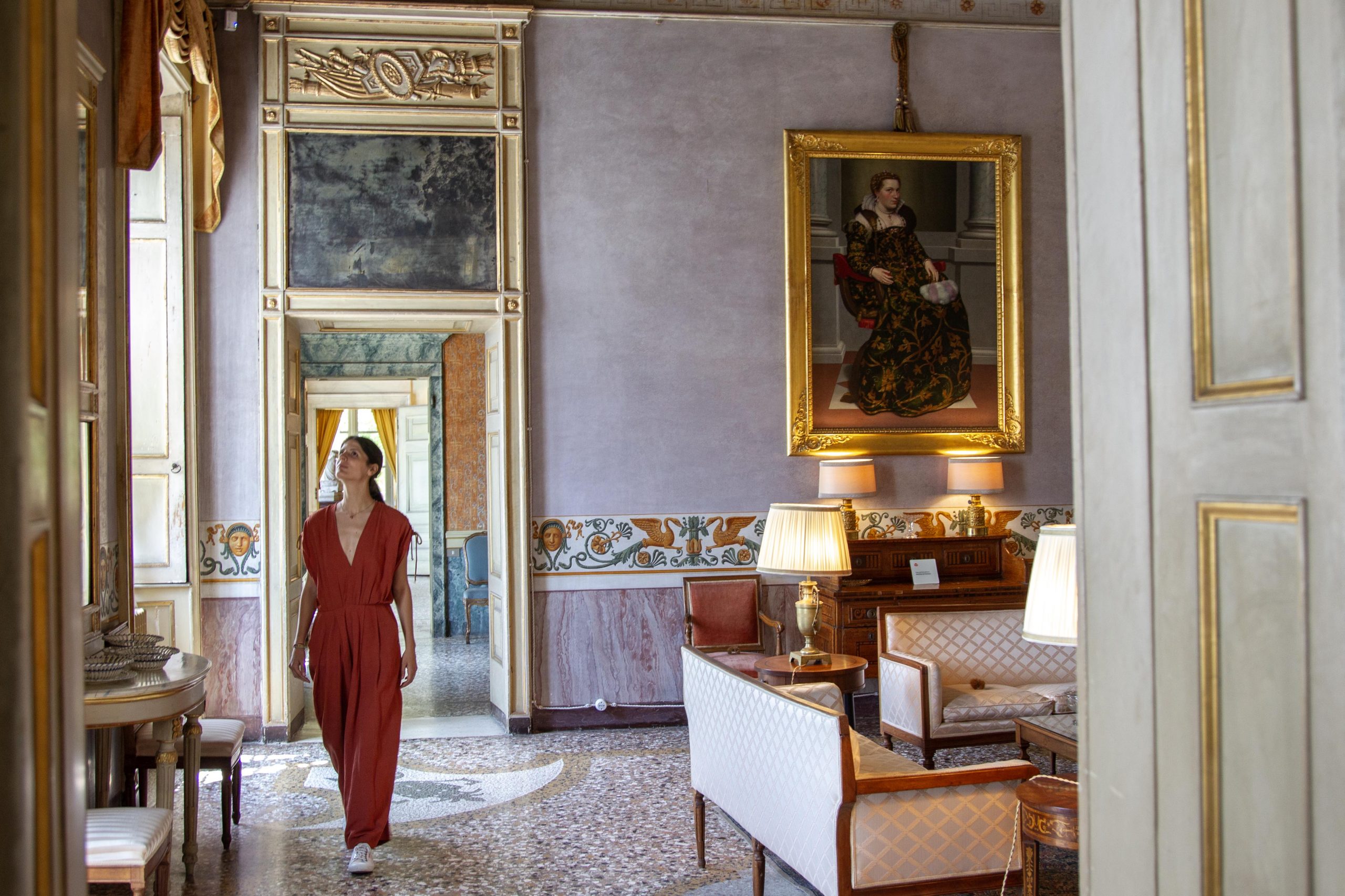
FAI’s commitment to greater inclusiveness and cultural accessibility continues with Palazzo Moroni in Bergamo. The Palazzo is the 12th FAI property that has been made accessible to visitors with intellectual disabilities as part of the “FAI property for everyone” project.
FAI is renewing its commitment to greater inclusivity and cultural accessibility, extending the “Bene FAI per Tutti”* project dedicated to people with intellectual disabilities and launched in 2016 to allow all visitors to fully experience the FAI properties* without difficulty, to more and more special places.
Palazzo Moroni, in the heart of Bergamo’s Upper City, will be added in 2024, bringing the number of FAI properties covered by the project to twelve. The initiative – devised and implemented by the Associazione L’abilità Onlus and made possible thanks to the invaluable support of Viatris, Nora McNeely Hurley / Manitou Fund with Friends of FAI and a major private donor – has over the years involved an increasing number of FAI properties throughout Italy, and for each of them, it is now possible to download special guides in simplified language (suitable for both adults and children and young people) from the website www.benefaipertutti.it, which are constantly updated thanks to the important work of a multidisciplinary team: experts in cultural heritage and accessibility, pedagogues, neuropsychomotricists, psychologists and educators. These are easy-to-read texts enriched with photographs, illustrations and maps, which make the visit an inclusive and enjoyable experience and allow guests and their caregivers (parents, teachers, carers) to familiarise themselves with the places and learn their history, characteristics and curiosities in an engaging way, thanks to communication tools designed to reduce the stress and difficulties of understanding the context of people with disabilities, removing the barriers that prevent them from being an active part of the visit.
FAI PROPERTIES INVOLVED IN THE PROJECT
From the north to the south of the peninsula, the FAI properties currently included in the project are Villa Necchi Campiglio in Milan, Villa e Collezione Panza in Varese, Masino Castle and Park in Caravino (TO), Negozio Olivetti in Venice, Villa dei Vescovi in Luvigliano di Torreglia (PD), Torre and Casa Campatelli in San Gimignano (SI), Villa Gregoriana in Tivoli (RM), Bosco di San Francesco in Assisi (PG), Casa Noha in Matera, Abbazia di Santa Maria di Cerrate in Lecce, Giardino della Kolymbethra in Agrigento and, from today, Palazzo Moroni in Bergamo. For all these places, specific visit itineraries have been created – to be carried out independently or with the Property’s staff, individually or in small groups – conceived with an inclusive perspective, with the idea that everyone has different abilities that can be enhanced in a cooperative learning context.
As FAI General Manager Davide Usai explains: “For FAI, the Bene FAI per tutti’ project is now more crucial than ever: the themes of inclusion and accessibility, which have always been an integral part of our mission*, have become essential to broaden the opportunities for visits and make beauty and culture accessible to all. Since 2016, when the project was launched in collaboration with the Associazione L’Abilità, over 1,200 people with cognitive disabilities, together with their caregivers, have visited our properties.”
“The facilitated-language guides we have created for Palazzo Moroni together with FAI staff open the doors to people with intellectual disabilities to accompany them on a discovery of the city’s noble palace, where the public and private spheres are intertwined, and which are not easy to recount to this type of audience,” says Carlo Riva, Director of L’abilità Onlus. “This continuous balance between the living dimension and the more museum-like and representative dimension can be breathed in the illustrated pages of the materials created for this imposing palace. In the guides we have carefully described both the original decorations, such as the paintings in the Golden Age Room, and the furnishings added later, in harmony with the identity of the space. It is a journey through time and environments that, in an intense educational effort, we have recounted in pages where the eyes and minds of children and adults with intellectual disabilities are activated to learn to observe, and above all understand, the beauty of history and art with multiple stimuli that the palace presents at the same time: frescoes, paintings, furniture, functions of the rooms and the garden“.
*articles in Italian

 Instagram
 Facebook